
Trials and Glory
My Dear Family,
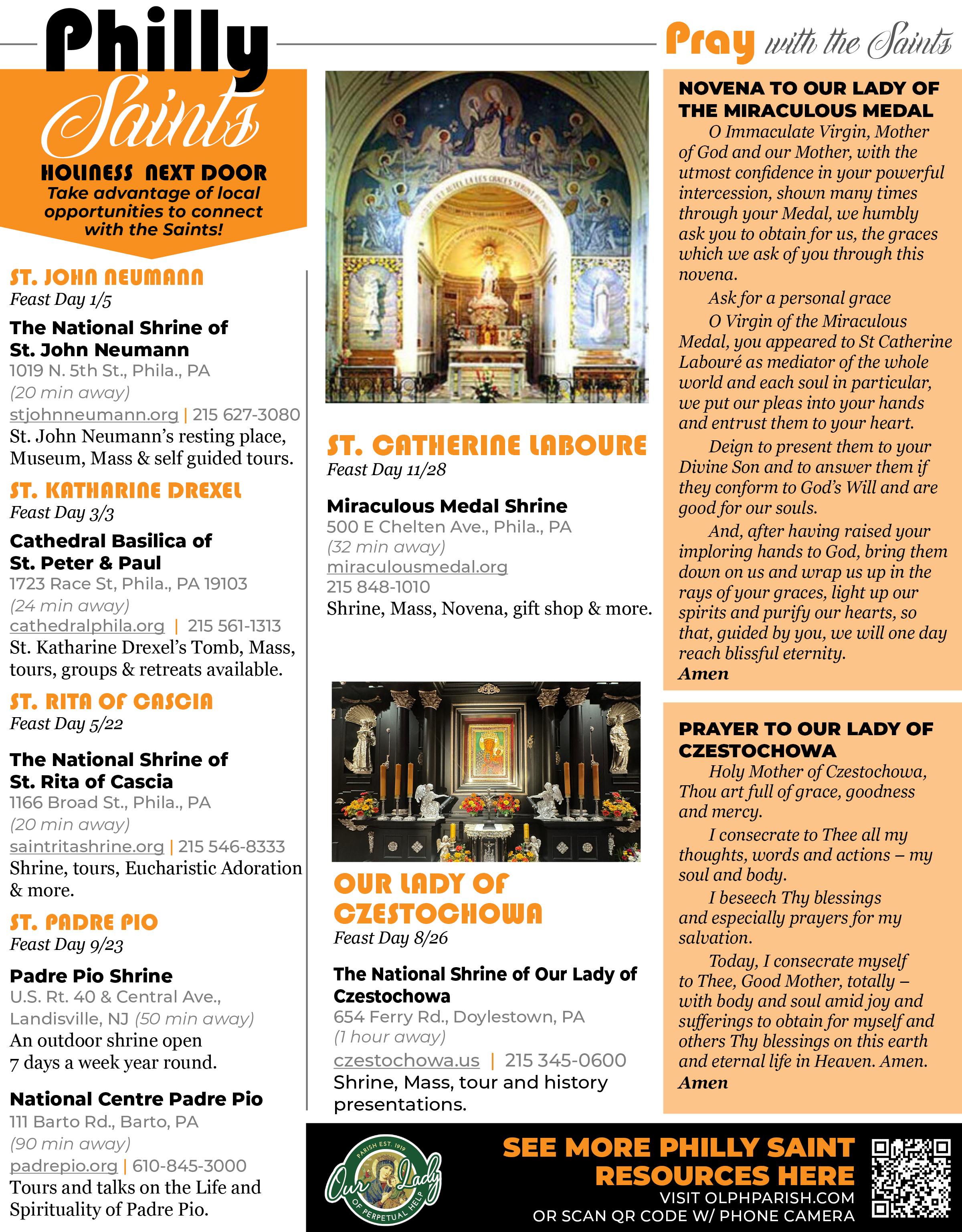
Our time with the Philly Saints draws to a close this week, but we hope that it has served to kindle or rekindle a friendship with some of our local Saints. Please save the bulletin with information about making visits to shrines in the area. From ancient times, people journeyed by foot with prayer and fasting, begging for food and hospitality along the way, as they visited holy sites in penance and supplication. For us now, it is just a short drive away. A pilgrimage is a wonderful way to lift the spirit!
Our theme this week is trials and glory. “Those who sow in tears shall reap rejoicing,” as the Psalmist (126:5) says. The grain of wheat must fall to the ground and die, and only in so doing, it bears much fruit! (John 12:24). A pattern emerges. Those who belong to Jesus are invited to share in his suffering and death. Before Christ, human sufferings could be understood as part of a misery, the lot of a fallen world. But united in Christ, our trials gain new meaning in the glory of Easter morning. Every Good Friday is followed by Easter Sunday. Hence, our respect and fascination for the holy martyrs who like Christ, paid the ultimate price with their lives.
Our readings this week echo this reality in different ways. The Gospel (Mk 10:35-45) follows immediately from Jesus' third passion prediction: “mock him, spit upon him, scourge him, and put him to death, but after three days he will rise.” Hearing this, oddly, James and John seek the places of honor when Jesus comes “into glory.” Non sequitur? Yet, Jesus moves forward with the question, “Can you drink the cup that I drink or be baptized with the baptism with which I am baptized?” Originally, baptism meant to dip or to dunk. Here, we might use the word “bathe,” to be bathed or dunked in the blood of the passion. Jesus points out an incredibly challenging road. The way that leads to glory traverses Golgotha.
The Letter to the Hebrews (4:15) describes the high priest who is “tested in every way yet without sin.” The same one sympathizes with our weaknesses; He knows us. He has endured heat and cold, hunger and thirst, heartache, and temptation, all without sin. So, we can approach the “throne of grace” with confidence.
Finally, our first reading today is part of the Songs of the Suffering Servant. Mysterious passages from Isaiah lead many fathers to call the Book of Isaiah “the Fifth Gospel.” Part of the song says, “If he gives his life as an offering for sin, he shall see his descendants in a long life.” Somehow mystically and paradoxically, the servant offers his own life and yet literally sees “his seed” in a prolongation of life. For me, this is about the saints who come after the anointed one and follow in his footsteps, not biological, but spiritual descendants. As Saint Paul says, “For if we have grown into union with him through a death like his, we shall also be united with him in the resurrection” (Rom 6:5). United with Christ our Lord in death or a baptism, we might say we shall be united in his resurrection.
There is that pattern again. Jesus did not suffer so that we did not have to; Jesus suffered so that we could, too, so that our trials would gain new meaning and new glory. Jesus offers his life for the salvation of the world, and that one offering was sufficient and acceptable for the salvation of the entire world, but our Lord also encourages us to unite our sufferings to his. Indeed, when we unite our suffering with those of the Master, we become part of the mystery of salvation. That is the pattern of the saints.
Hence, we invite you to become pilgrims, to be on the journey with our Lord, to struggle to visit one of the holy shrines and to be united with that long line of spiritual descendants who show us how to unite our own burdens to the Cross and so be welcomed into glory. “Sing with all the Saints in glory, sing the resurrection song!”
At the foot of the Cross,
Fr. Wilson