Alumni
Connect with other classmates by joining our Facebook Group
click here
Stay up to date with communications from OLPH
click here
To view the OLPH Memory Lane YouTube Slideshows
click here
OLPH Memory Lane Book -
*Sign-in or create a Shutterfly account to view and/or purchase
*The cost is approx. $26 plus tax/shipping ($38 total)
*It is a softcover 10" x 10" booklet
*This is not a yearbook and OLPH is not making a profit off the books.
click here
|
History
At the turn of the 1900’s all the Catholics in this area traveled to Moorestown for all their religious functions.
- 1919 the Catholic population of Maple Shade was large enough to have its own parish, and in May, Our Lady of Perpetual Help parish was formed and the boundaries assigned. Father Dineen celebrated the first Mass in the silk mill on Stiles Avenue. This building served as a church until the growth of the parish demanded larger quarters.
- March 14, 1920, Mass was celebrated in the auditorium of the school on Poplar Avenue which was rented from the Board of Education until April 3, 1921.
- October 11, 1920 ground was broken for the first church which seated about 300 on Main Street between Poplar Avenue and Fellowship Road.
- April 10, 1921 First Mass was celebrated in the new church. The cornerstone was laid by the late Most Reverend Thomas Walsh, Bishop of Trenton, on April 24, 1921.
- September, 1928, school classes were held in the church building in Maple Shade for the first four grades. During these years, the Sisters of Mercy came from St. Mary’s in Camden to instruct the children in Christian Doctrine.
- May 14, 1929, Father Leo Dineen was appointed first permanent resident pastor. Work was begun immediately on an addition to the church and four additional classrooms. (The first graduating class was that of 1930.)
- September 1936 the Convent for the Sisters of St. Joseph was dedicated.
- April 18, 1955 ground was broken by Father Nolan for the new church. A Georgian colonial style, this beautiful church could seat 900.
- November 4, 1956 the church was dedicated and blessed by the late Bishop Ahr.
The church seeks but a solitary goal: to carry forward the work of Christ Himself under the lead of the befriending Spirit. “To serve and not to be served”. "Ministrare non Ministrari"
|
|
THE SYMBOLS OF OUR LADY OF PERPETUAL HELP: THE ICON
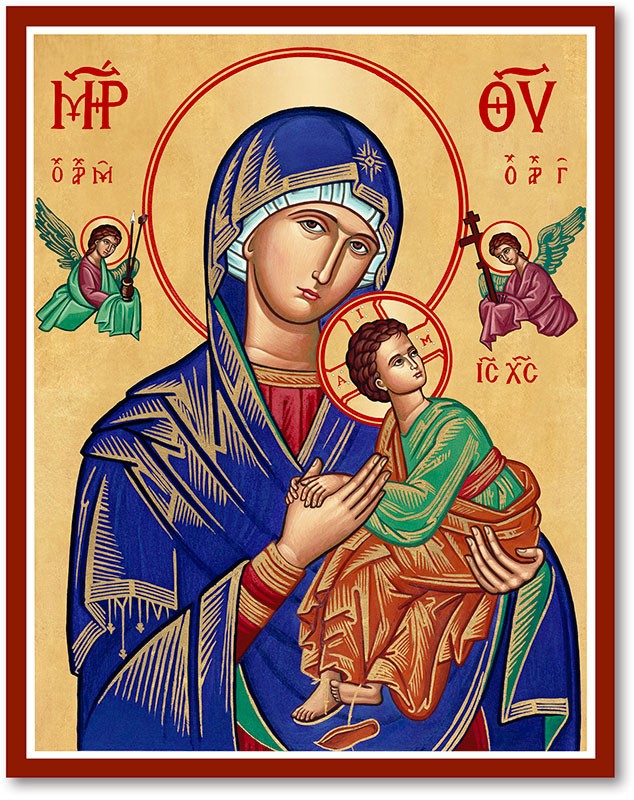
Let's take a closer look at the icon of Our Lady of Perpetual Help by exploring some of the artistic and historic elements. These elements are such an important part of our Parish. We are surrounded by items of great beauty, deep meaning and rich tradition. She is reflected in our Parish logo, various statues on the interior and exterior of our campus, at the very top of our altar and among our gorgeous stained glass windows.
The History
This particular painting is claimed to be the first icon ever created. St. Luke was said to have painted this during Mary’s lifetime. He is the Author of the Gospel of Luke and the Acts of the Apostles. It's no coincidence that he is also the patron saint of artists. The original icon is painted on wood and measures about 20“ in height. At various times the icon was in Crete, Rome and Paris. Today it is permanently enshrined in the Church of Saint Alphonsus Liguori, Rome. Mary was said to have given it a special blessing and so the icon is known for being miraculous. Over the centuries countless healings and special graces have been attributed to it.
The Elements
Greek Characters
- ΜΡ θΥ = Mother of God.
- O AP M = the Archangel Michael; to Mary's right
- O AP I O = the Archangel Gabriel; to Mary's left
Mary's Star
- Reminds us she is the dawn announcing the coming of Jesus.
- Symbolizes the role of Mary in the mystery of Christ and the Church.
- The star indicates that she is the one who will lead us to Christ.
Mary’s Eyes
- Mary’s eyes are filled with compassion and love, are fixed on us, her children on earth.
- She is our source of constant comfort and hope.
- Her eyes draw all who look into her face toward the mystery of Redemption which she holds in her arms.
Archangel Michael
- He is holding a lance, a pole with a sponge, and a vessel of vinegar.
- These prefigure scenes from Jesus’ crucifixion.
- The Archangel’s veiled hands inculcate reverence for holy things.
Archangel Gabriel
- He is holding a cross and nails, the very instruments of the coming death that has driven the boy Jesus to His mother’s safe embrace.
- His veiled hands inculcate reverence for holy things.
Mary’s Cloak
- The colors of Mary’s cloak symbolize both her virginity (red) and motherhood (blue). These are also the colors of royalty.
- Blue is the color worn by mothers in Palestine, symbolic that Mary is both virgin and mother. Her red tunic underneath is the color worn by virgins during the time of Jesus.
Mary’s Hands & Arms
- Mary’s hands and arms hold Jesus in a manner that indicates she is presenting Him to us.
- Her right hand points directly into the heart of the Christ Child, up to the Cross the angel is holding.
- Her left hand position, along with the view of the right hand, is one of presenting the Child to those who stand before the icon as she says: “Receive the Word of God.”
The Face of Jesus
- The Christ Child looks out beyond the instruments of His passion to our future redemption.
- While Jesus’ body is that of a child, His face is more mature, symbolizing wisdom beyond His years.
Jesus’ Hands
- The joining of his hands with his mother’s signify the perfect conformity of Mary’s will with Her Son’s, and that together with Him, she participated in the work of the Redemption.
Jesus’ Clothes
- His green tunic symbolizes His humanity and creation.
- The red sash around His waist symbolizes the Blood of Christ shed for our salvation.
- The gold cloak is symbolic of the Resurrection.
- Together, the colors of the garments are a statement of the Incarnation, Passion, Death and Resurrection of Christ.
Mary’s Face & Mouth
- The smallness of her mouth teaches us to be silent before the presence of God.
Jesus’ Feet & Sandals
- The dangling sandal of the baby Jesus implies that he lept to the comfort of Mother Mary in anticipation of the Passion. He went so quickly that he shed his sandal.
The Gold Background
- The gold background represents heaven and the divine light of the Resurrection shining through the garments of Jesus and Mary entering into the one praying before the image.
|